1.6 The Phosphorus Cycle
Do three things: a photo challenge, a hands-on lab, and a quick check.
Unit 1 · Topic 1.6
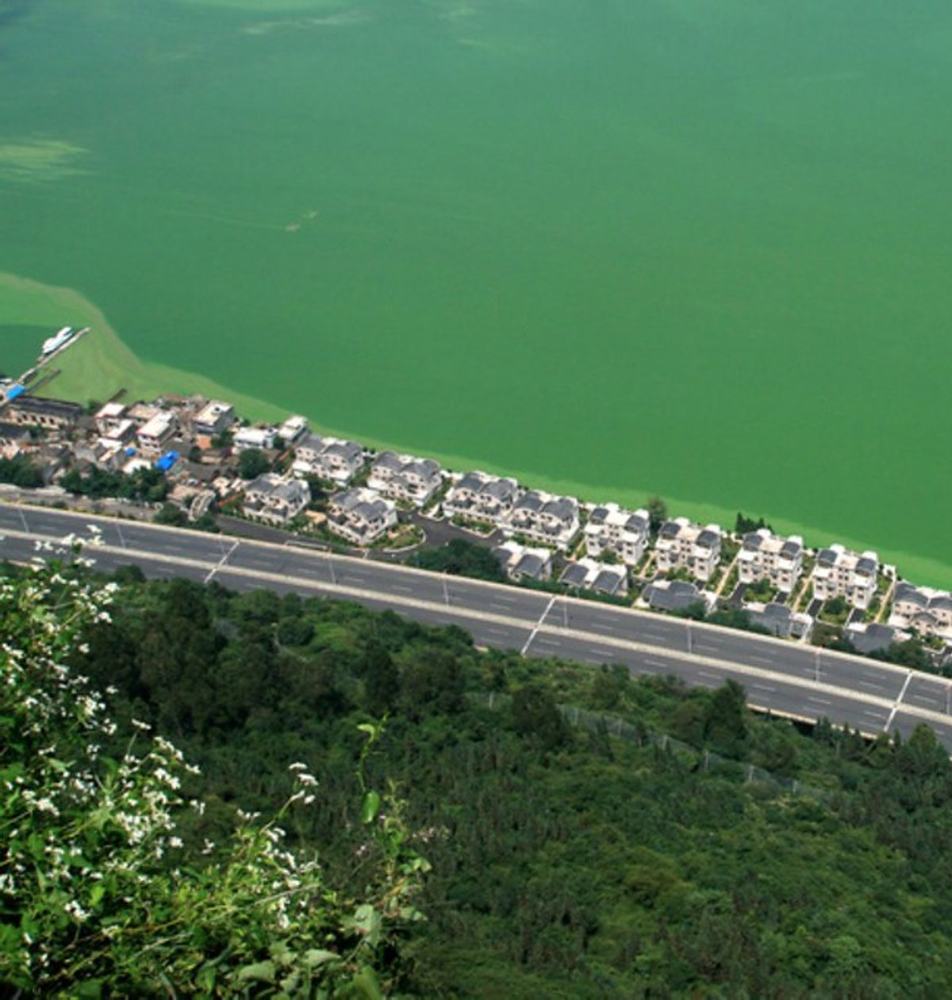
Why can one bag of fertilizer turn a clear lake green?
Do 1Reservoir, input, or effect?
Look at the photo. Place it in the phosphorus story.
Do 2Four tanks
Run each tank of lake water for two weeks. See what grows.
Algae growth--
Which nutrient is limiting algae growth in this lake?
Do 3Quick check
Your topic score
Try the lake eutrophication simulator
Key terms
- No gas phase
- Phosphorus has no significant atmospheric reservoir, so its cycle is slow.
- Weathering
- The slow breakdown of rock that releases phosphate into soil and water.
- Limiting nutrient
- The nutrient in shortest supply, which controls growth.
- Eutrophication
- Nutrient enrichment of a water body, which causes algal blooms.
- Hypoxia
- Low dissolved oxygen that can suffocate fish.
- Algal bloom
- A rapid growth of algae, often from added nutrients.
Photo credits
- River cutting through canyon rock. Photo: mypubliclands (CC BY 2.0)
- Clear mountain lake. Photo: romainguy (CC0)
- Algae and a dead fish in a lake. Photo: eutrophication&hypoxia (CC BY 2.0)
- Drain pipe discharging into a stream. Photo: USDA (Public domain)
- Algal bloom, Lake St. Clair (NASA). Photo: NASA Goddard Photo and Video (CC BY 2.0)
- Algal bloom on a lake. Photo: eutrophication&hypoxia (CC BY 2.0)
- Open-pit phosphate mine. Photo: U.S. Forest Service (Public domain)
- Layered sedimentary rock. Photo: James St. John (CC BY 2.0)
- Tractor spreading fertilizer. Photo: aqua.mech (CC BY 2.0)
Photos are public domain, CC0, or CC BY. Diagrams and data are original to Green Flask Science.
Teaching AP Environmental Science?
The Green Flask Science™ full-year APES bundle covers all nine units with slides, guided notes, original activities, simulations, and quiz and test banks.