1.4 The Carbon Cycle
Do three things: a photo challenge, a hands-on lab, and a quick check.
Unit 1 · Topic 1.4
Where was the carbon in your body 100 million years ago?
Do 1Source, sink, or reservoir?
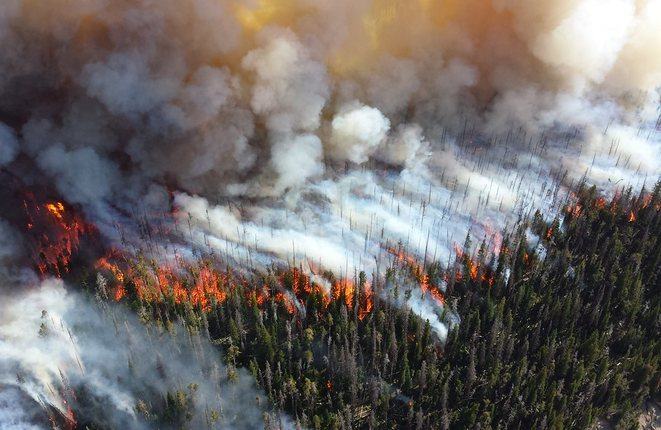
Look at the photo. Decide what it does for carbon.
Do 2Carbon budget
Set the flows in gigatons of carbon per year (GtC/yr). The sliders start near recent values.
Sources
Sinks
Net added to the air
Rounded values after the Global Carbon Budget. About 2.1 GtC added to the air raises CO₂ by about 1 ppm.
Do 3Quick check
Your topic score
Key terms
- Carbon source
- Releases more carbon to the atmosphere than it takes in.
- Carbon sink
- Takes in more carbon than it releases.
- Reservoir
- A place that holds carbon for a long time, such as rock, fossil fuels, or deep ocean water.
- Photosynthesis
- Producers use CO₂, water, and light to make sugar and oxygen.
- Cellular respiration
- Cells break down sugar for energy and release CO₂.
- Combustion
- Burning, which quickly releases stored carbon as CO₂.
Photo credits
- Cleared forest, Amazon. Photo: Matt-Zimmerman (CC BY 2.0)
- Forest. Photo: elias_daniel (CC BY 2.0)
- Fossil plants in carbonaceous shale. Photo: James St. John (CC BY 2.0)
- Limestone cliffs, Grand Canyon. Photo: Grand Canyon NPS (CC BY 2.0)
- Fallen tree decaying on a forest floor. Photo: shankar s. (CC BY 2.0)
- Coal-fired power plant. Photo: Rennett Stowe (CC BY 2.0)
- Coral reef, Rose Atoll. Photo: USFWS Pacific (Public domain)
- Augustine volcano eruption, 2006. Photo: U.S. Geological Survey (CC0)
- Wildfire. Photo: NPS Climate Change Response (Public domain)
Photos are public domain, CC0, or CC BY. Diagrams and data are original to Green Flask Science.
Teaching AP Environmental Science?
The Green Flask Science™ full-year APES bundle covers all nine units with slides, guided notes, original activities, simulations, and quiz and test banks.