1.3 Aquatic Biomes
Do three things: a photo challenge, a hands-on lab, and a quick check.
Unit 1 · Topic 1.3
What decides where a coral, a kelp, or a trout can live?
Do 1Name the aquatic biome
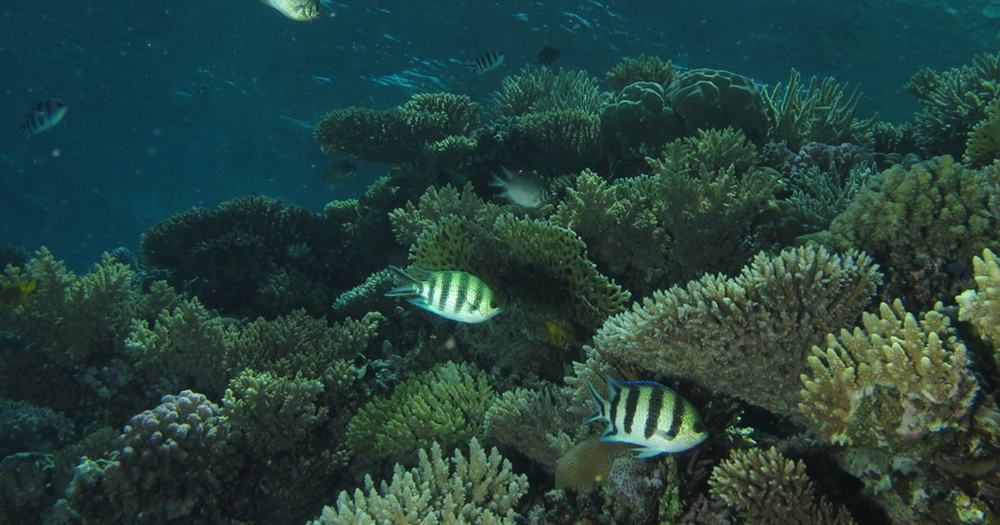
Look at the water. Pick the biome.
Do 2Cloudy water
30
Sunlight reaching the seagrass
Seagrass needs roughly 10 to 20 percent of surface light. Light fades quickly as the water gets cloudier.
Do 3Quick check
Your topic score
Key terms
- Salinity
- How salty the water is: fresh, brackish, or marine.
- Turbidity
- How cloudy water is from suspended particles. High turbidity blocks light.
- Littoral zone
- The shallow, sunlit lake zone near shore.
- Benthic zone
- The bottom of a lake or ocean, where decomposers and bottom dwellers live.
- Estuary
- Where a river meets the sea, with brackish water and high productivity.
- Phytoplankton
- Tiny floating producers that make much of Earth's oxygen.
Photo credits
- Estuary and marsh. Photo: mypubliclands (CC BY 2.0)
- Great Barrier Reef from the air. Photo: Studio Sarah Lou (CC BY 2.0)
- Kelp canopy. Photo: USFWS Pacific Southwest Region (CC BY 2.0)
- Lake with reeds. Photo: Forest Service Pacific Northwest Region (Public domain)
- Sediment plume from a river (satellite). Photo: NASA Goddard Photo and Video (CC BY 2.0)
- Coral reef. Photo: Derek Keats (CC BY 2.0)
- Seagrass bed. Photo: Derek Keats (CC BY 2.0)
- Mountain stream. Photo: Leshaines123 (CC BY 2.0)
Photos are public domain, CC0, or CC BY. Diagrams and data are original to Green Flask Science.
Teaching AP Environmental Science?
The Green Flask Science™ full-year APES bundle covers all nine units with slides, guided notes, original activities, simulations, and quiz and test banks.